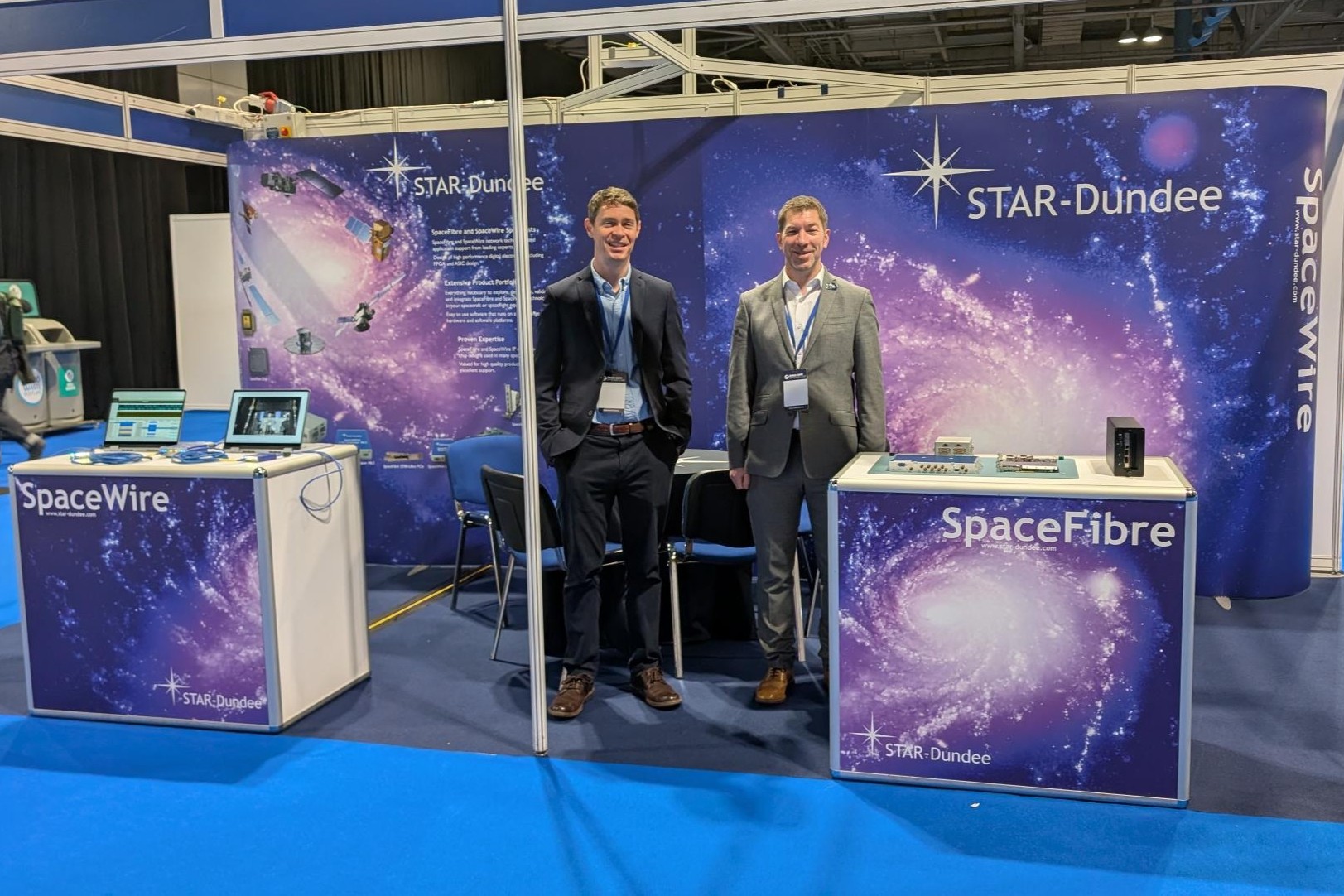
STAR-Dundee will be exhibiting at many events throughout 2026, as well as presenting papers at several conferences. We intend to release several new SpaceFibre and SpaceWire products this year and there will be an opportunity to see these up close at many of the events we’re attending.
Already in 2026, we’ve exhibited at the CEOI’s Technology Showcase in London, attended SpaceCom in Orlando, and demonstrated our IP operating in Microchip FPGAs in Ahmedabad and Bengaluru as one of the Microchip Partners at the Microchip India Space Forum.
March will be a busy month, beginning with Space-Comm Expo Europe in London, where we will have two forthcoming new products on display at our stand. The following week we’ll be exhibiting and presenting papers, including describing our SpaceVNX+ and 100 Gbit/s SpaceFibre developments, at the IEEE Aerospace Conference in Big Sky, Montana. Our US travels continue with a visit to Laurel, Maryland, where we are once again sponsoring the Flight Software Workshop and will be presenting a paper on Ultra-Fast, Low-Overhead SpaceFibre Communication for SoCs.
Throughout the remainder of the year, we will be visiting South Korea, Netherlands, Germany, more trips to the US, plus some events closer to home. The up-to-date list of events we’re attending can be found on the 2026 Events page of our website. Please visit our stand at these events, or get in contact if you’d like to arrange a meeting.
We have recently released STAR-System v6.01, which is an update to the common software suite used by all of our SpaceWire and SpaceFibre interface and routing devices. STAR-System includes a number of GUI applications used to perform common functions such as transmitting and receiving packets, device configuration and error injection. It also includes C, C++ and Python APIs for controlling the devices from your own applications.
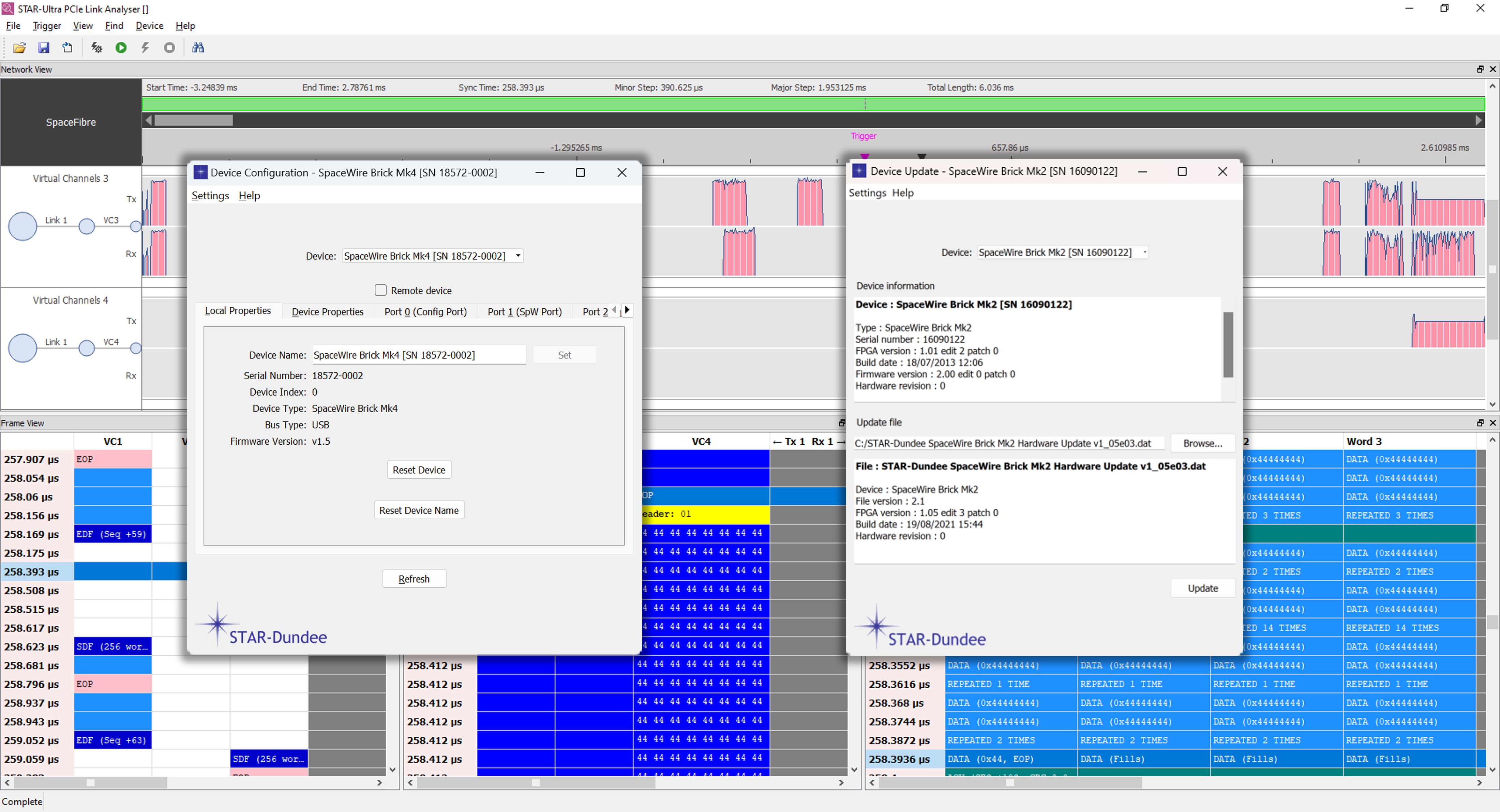
The most significant updates in STAR-System v6.01 are related to the triggering system in supported devices such as the SpaceWire Brick Mk4, SpaceWire PCIe Mk2, SpaceWire PXI Mk2, and, new in STAR-System v6.01, the STAR-Ultra PCIe Interface. In those devices, the triggering system allows events such as timers or external trigger input to cause actions such as transmitting packets or injecting errors. The initial configuration of the triggers is performed by software, but the implementation is in hardware, which allows low-latency and deterministic behaviour even when the device is running on a general-purpose operating system.
Firstly, the Generic Triggering API (and C++ and Python equivalents) has been updated to support triggering using SpaceFibre ports and virtual channels on the STAR-Ultra PCIe Interface. For example, it is now possible to queue SpaceFibre packets on a virtual channel and trigger them based on a number of different events including timers or external trigger input.
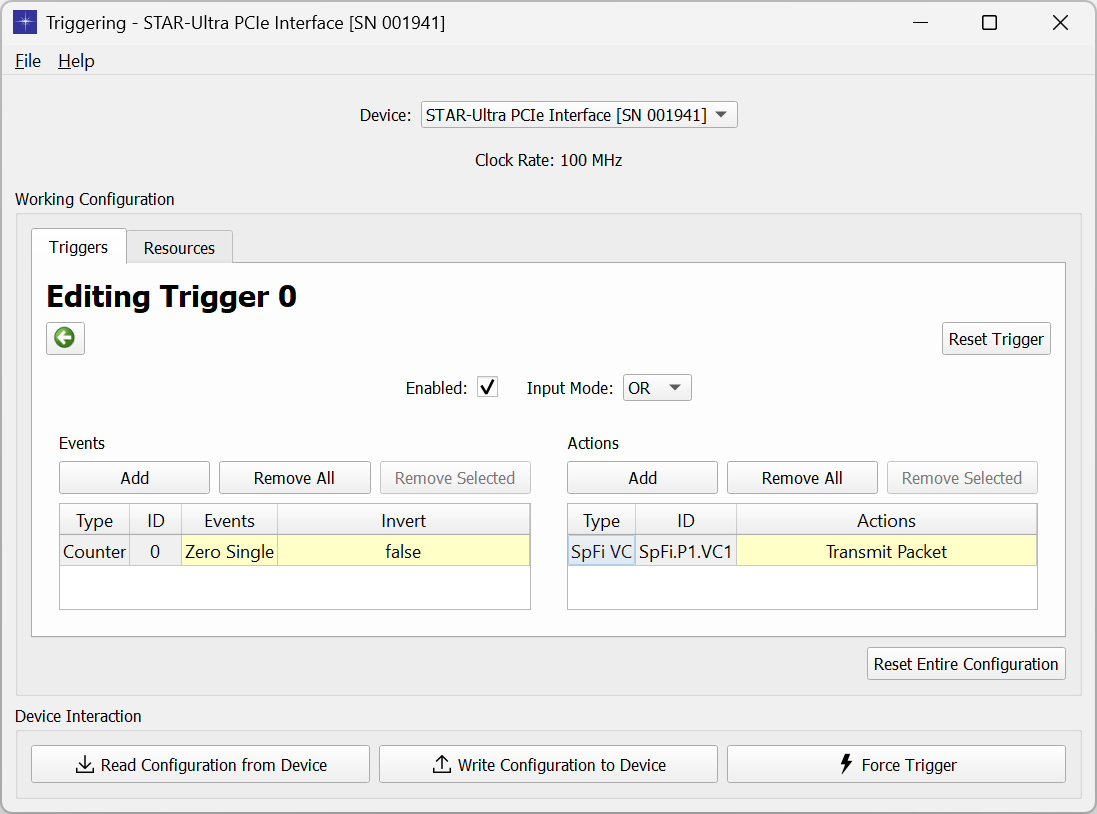
Secondly, we have developed a new version of the Triggering GUI application, improving the visuals and usability throughout, adding the ability to save and load trigger configurations to and from files, and including several example configurations for common use cases. For example, the following screenshot shows the trigger editing window, which is used to connect trigger events and actions, in this case using one of the counters to cause periodic transmission of packets on a SpaceFibre virtual channel:
The release also includes other improvements throughout the GUI applications, APIs, installers and documentation. In addition, the release includes improved support for various Linux distributions, including resolving installation issues on recent versions of multiarch distributions like Ubuntu, and Linux kernel compatibility has been tested up to kernel v6.17.7.
In addition to the triggering software updates in STAR-System v6.01, an FPGA update for the STAR-Ultra PCIe Interface, v1.07e06, has also been released. The update can be applied using the STAR-System Device Update GUI application and is required for full triggering support on the STAR-Ultra PCIe Interface.
STAR-System v6.01 and STAR-Ultra PCIe v1.07e06 are now available for download for registered users through the Support area of our website. If you don’t already have access to these downloads, please register your product on our Product Registration page.
Our SpaceFibre test and development product range has recently been expanded with the introduction of the STAR-Ultra PCIe Single-Lane Router. An 8-lane Gen 3 PCI Express board with eight single-lane SpaceFibre ports, each operating at up to 6.25 Gbit/s, and a high-speed interface to the host PC, the STAR-Ultra PCIe Single-Lane Router is capable of packet transfer between the host PC and the routing switch at data rates well in excess of 10 Gbit/s in both directions simultaneously. The switch itself has an effective user data rate (bisection bandwidth) of approximately 50 Gbit/s.
At the heart of the STAR-Ultra PCIe Single-Lane Router is a SpaceFibre routing switch with twelve ports:
Port 0 is the configuration port which can be accessed from any port of the SpaceFibre routing switch, permitting remote configuration, control and monitoring of the switch.
Ports 1 to 8 are the eight SpaceFibre ports, each with eight virtual channels.
Ports 9 and 10 are internal ports, each with eight virtual channels which are connected to a multi-channel host interface. This multiplexes the many individual streams of data over a PCIe Gen3 x8 lane interface, providing the high-speed interface to the host PC.
Port 11 is an internal port, used as a control channel interface, allowing the host PC to configure, control and monitor the SpaceFibre routing switch over the PCIe bus.
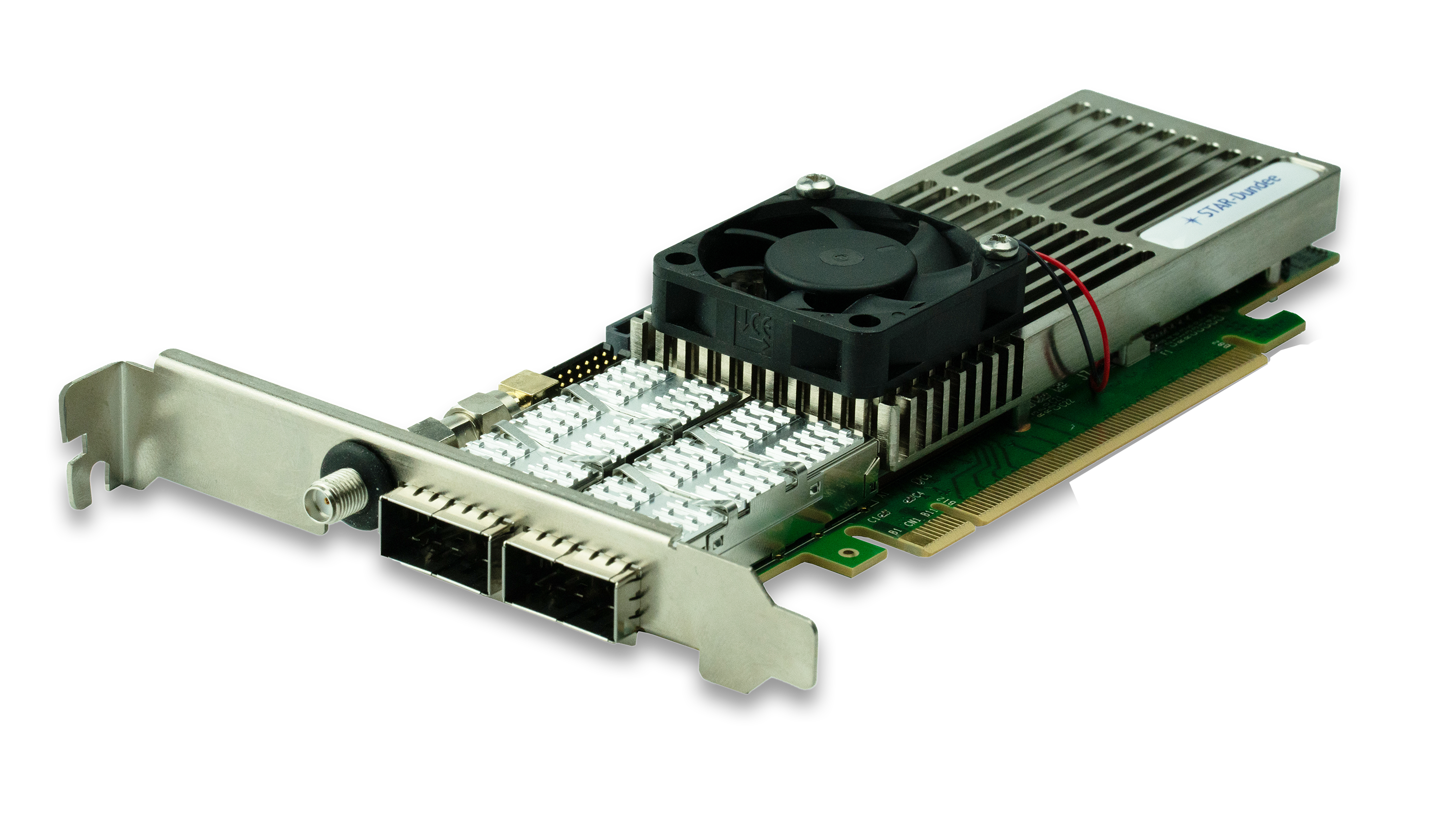
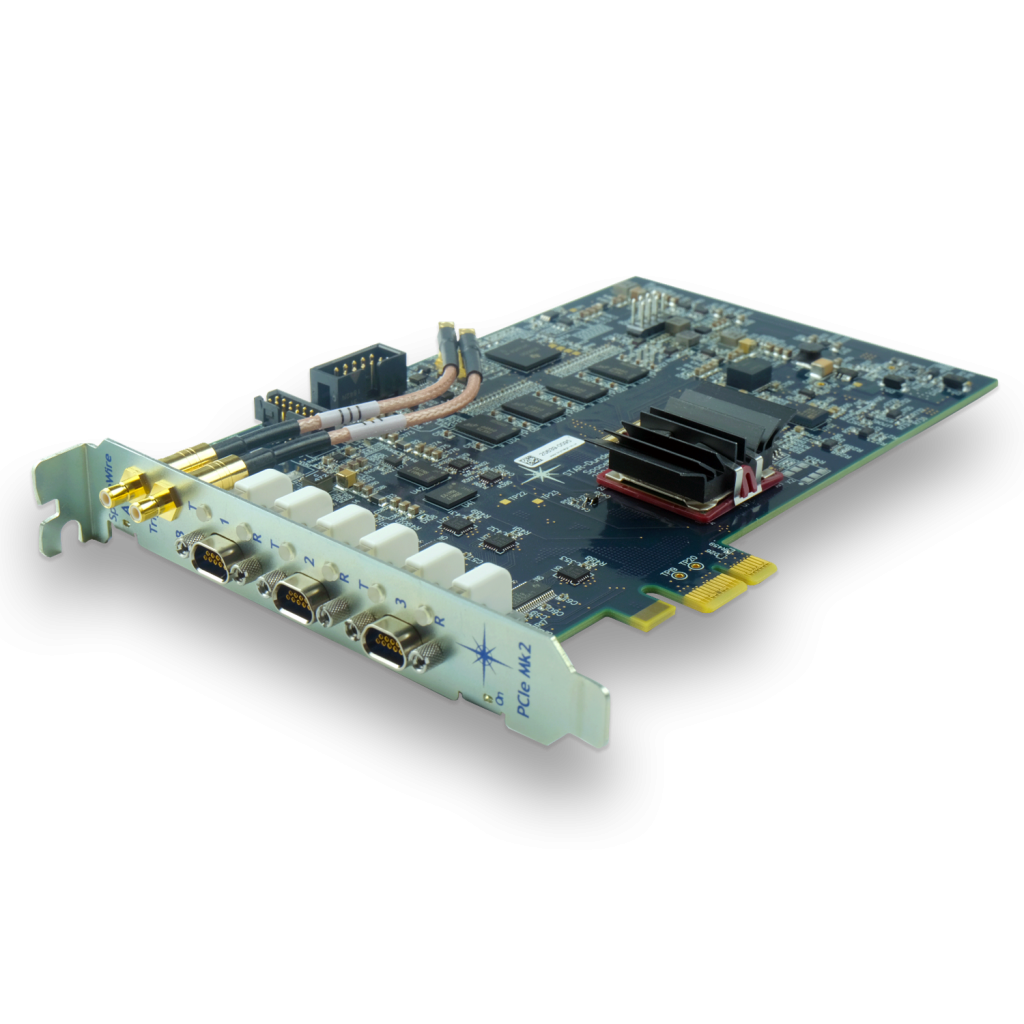
A new version of our other, existing STAR-Ultra product, the STAR-Ultra PCIe Interface, is also being released. The STAR-Ultra PCIe Interface is a SpaceFibre Interface device which provides two ports, with up to 4 lanes on each port. Among the many improvements, this new release features links with a configurable number of lanes, making it easy to communicate with SpaceFibre devices with single-lane or multi-lane interfaces, ensuring compatibility with various lane configurations.
A comparison of some of the key features present in the two products is shown in the table below.
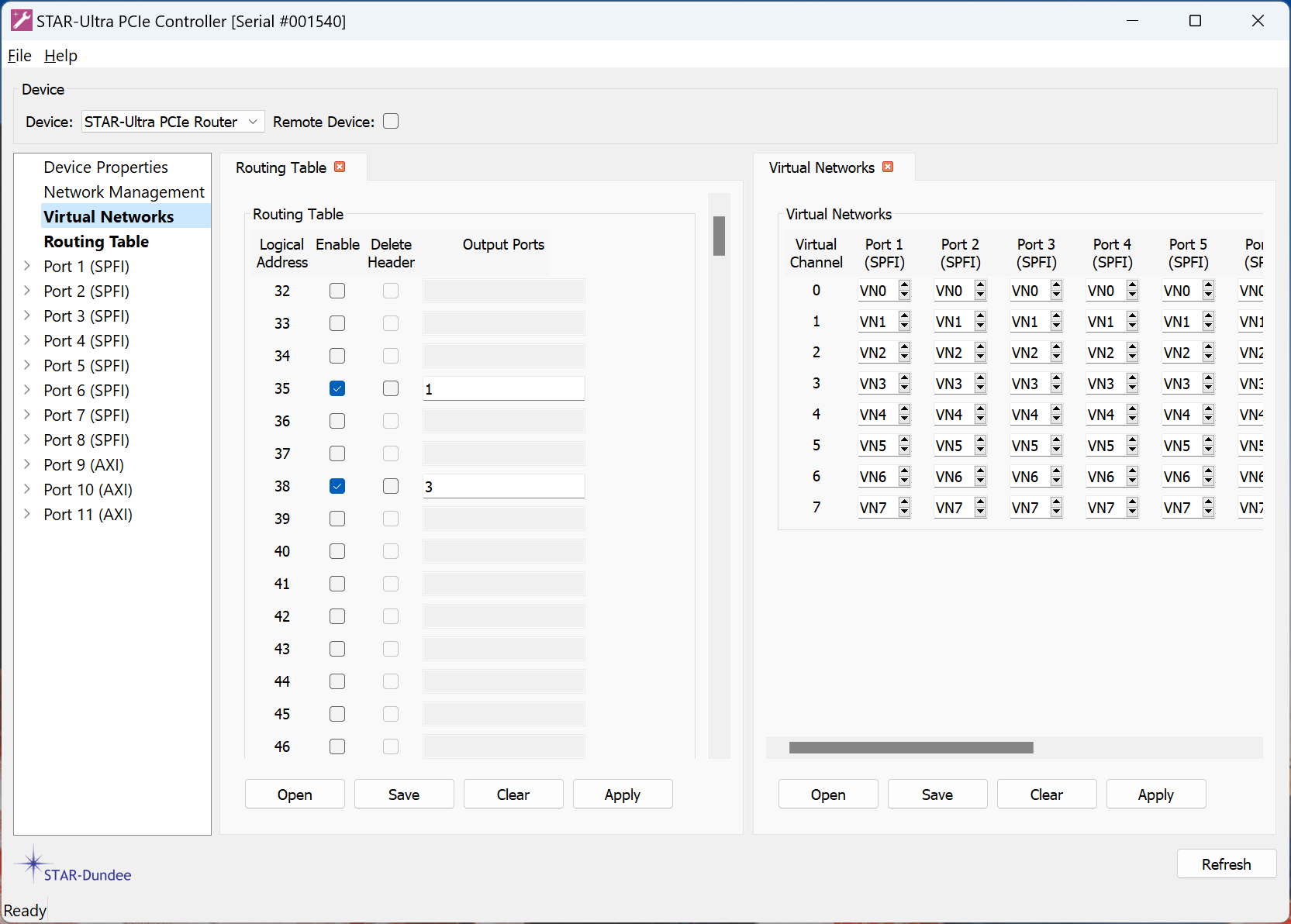
To coincide with these releases, a new version of the STAR-Ultra software applications has been released, supporting both the STAR-Ultra PCIe Interface and the STAR-Ultra PCIe Single-Lane Router products. The Controller application has been updated to support the control of functionality in routing switches and has also been expanded to allow multiple tabs to be opened concurrently. This makes it possible to configure a device’s Routing Table while also viewing its Virtual Network configuration, for example.
In addition, a new major version of the STAR-System software suite has been released, version 6.00, to support the STAR-Ultra PCIe Single-Lane Router. STAR-System provides the drivers, APIs and graphical applications for accessing all our SpaceFibre and SpaceWire products and this latest release includes several new features. As part of the support for the STAR-Ultra PCIe Single-Lane Router, a new SpaceFibre Configuration API has been added to provide functions to configure different SpaceFibre device types in a consistent manner. Among the improvements potentially of interest to existing STAR-System users is support for the latest Linux kernel at time of release, version 6.11.2. Registered users can download this latest release from the STAR-System downloads page.
As part of our efforts to reduce our environmental impact, STAR-Dundee recently moved to electronic delivery of the software provided with our products and will no longer be shipping CDs with products unless specifically requested to do so. This has the added advantage of ensuring that users receive the latest software when they first begin using their new product.
To receive access to the latest updates for your product, whether it’s a recent purchase or a well-used unit bought 20 years ago, please register the device’s serial number on the PRODUCT REGISTRATION page in the SUPPORT section of our website. This registration process ensures that you’re given access to the correct updates for your products and an option is also offered to receive notifications when new updates are released for the products you register. If you’ve not yet received your products, you’re also welcome to register the products you’ve ordered by entering the purchase order number preceded by “PO” in the serial number field of the Product Registration page. This will allow you to start using the software and begin development using the APIs before you receive the devices.
If this is the first time you’ve registered a product, you will be given a new account for accessing downloads. You’ll then be given access to the downloads for the products you’ve registered. These downloads can be accessed from the PRODUCT SUPPORT page, which is again in the SUPPORT section of our website. If you’ve not already logged in, you can login using the LOGIN TO ACCOUNT button on this page or the LOGIN link at the top of any page. You’ll then see the list of products you’ve registered in the menu on the right-hand side. Note that many products make use of our STAR-System software suite which has its own downloads page and will also be listed in the right-hand menu.
We are continually improving our products and frequently release updates to both software and firmware, adding new features not initially present, plus support for new operating system versions. As part of our commitment to providing the best possible support, these updates are made available to all registered users through the download pages.
With the Space Industry continuing to grow, we look forward to meeting both new and current connections and will be attending both well-established and new events. In May, we will be returning to Space Tech Expo USA in Long Beach for the first time in several years and will attend the first Canadian Space Week in Montreal and Longueil. Closer to home, we’re also looking forward to the first ever Space-Comm Scotland in Glasgow.
We’re currently planning to exhibit at or attend the following conferences, exhibitions and trade shows in 2024:
A second generation of our widely used SpaceWire PCIe board is now available with several improvements over the original product. The SpaceWire PCIe Mk2 board is a three port SpaceWire interface and router device, suitable for all stages of SpaceWire equipment development: initial SpaceWire evaluation, instrument simulation, control system simulation, unit testing, and spacecraft equipment integration support. The board is backwards compatible with the original SpaceWire PCIe (Mk1) board and adds extensive fault protection to meet most FMEA requirements. The new board also includes two external triggers not present on the Mk1, to enable synchronisation of packet transmission with external events and signalling of packet reception, and other events, to external equipment.
To facilitate fault protection, the SpaceWire PCIe Mk2 is powered from both +3.3V and +12V, compared to the Mk1, which is powered by +3.3V only. The power for both +3.3V and +12V supplies is taken from the PCIe slot that the board is plugged into.
As with the SpaceWire PCIe Mk1 and many of our other SpaceWire and SpaceFibre products, the SpaceWire PCIe Mk2 is supported by STAR-Dundee’s STAR-System software, making it simple to move from another product to the PCIe Mk2. Example command line applications are provided with source code to demonstrate common tasks, and to test a device’s throughput and latency. GUI applications are also provided to support the configuration of devices, the transmission and reception of packets and time-codes, and to inject errors.
SpaceWire PCIe Mk2 boards have now been shipping to initial customers for several months while we have worked to build up sufficient stock to fulfil future orders.
Due to our ongoing success and to allow us to further grow, we’re seeking to recruit several new employees in different areas of the business.
The positions we’re looking to fill include an Electronics Test Engineer, a Sales and Procurement Assistant, and several Electronics and FPGA Engineers. Each of these roles will provide the opportunity to contribute to the development of STAR-Dundee’s innovative spacecraft on-board network technology and electronic test equipment. This technology is already being used on spacecraft monitoring the Earth’s land, oceans and atmosphere, exploring Mars, visiting and bringing back samples from asteroids, mapping the stars in our galaxy, providing GPS and communication services, preparing to resume human exploration of the moon, and on many more Earth observation, scientific, astronomy and exploration missions.
As well as being a leading supplier of spacecraft on-board network technology and electronic test equipment, STAR-Dundee is an employee-owned company, with over 50% of the company shares owned by an Employee Ownership Trust on behalf of the employees. Staff are represented on this Trust and on the Board of Directors, and also benefit, when there’s a dividend payment to the other shareholders, with a tax-free or partially tax-free bonus.
The successful candidates will be based in our office in the heart of Dundee, Scotland, a renovated 19th century town house overlooking the Tay estuary. Dundee, Scotland’s fourth largest city, was listed by Lonely Planet in 2018 as one of the top ten best European destinations to visit and praised for its ‘head-turning’ urban redevelopment.
Further details on the vacancies, including detailed job descriptions with information on applying, can be found on our Vacancies page.
We’re glad to be attending face-to-face events again after participating online for the past couple of years. This year, we kicked off with Paris Space Week in February and travelled to Utah for The SmallSat Conference in August.
We have a busy few months ahead, and we’re looking forward to seeing everyone again, as well as meeting many new people.
STAR-Dundee will be exhibiting at or attending the following conferences, exhibitions and trade shows in 2022:
It was a momentous occasion earlier this week for STAR-Dundee as we celebrated our 20th anniversary!
Started in 2002, STAR-Dundee was born out of the Space Technology Centre at the University of Dundee, which led the technical work on the SpaceWire standard, something which staff at STAR-Dundee have been instrumental in for more than 20 years.
We are very proud to be a world leader in both SpaceWire and SpaceFibre technology.
We would like to take this opportunity to thank all our talented and dedicated employees at STAR-Dundee for making our success story possible.
And to the valued users of our products, we express our thanks to you for trusting us for many years and making us the leader in our field.
We are excited about the opportunities that lie ahead and drive us to extend our track record of innovation and success.
To meet growing demand for our technology and products, and to aid in our continuing growth, we’re seeking to recruit several new employees.
We’re looking for an Executive Assistant to assist our CEO in day-to-day activities and in several areas of importance to the company. These include promoting the company’s products and technologies internationally, supporting the company’s employees, and growing the company’s relationships with suppliers, partners and the local community. This role’s open to people with a range of backgrounds including science, engineering, management, marketing and legal. A scientific/engineering background would be helpful but isn’t essential.
We are also looking for several engineers with backgrounds in electronic circuit board, FPGA or ASIC design. These engineers will work on chip design and/or unit design, contributing to the development of new products and technology for spacecraft applications. We’re looking for people with at least two years’ industrial experience and with a 1st class degree or equivalent experience.
The successful candidates will be based in our office in Dundee, Scotland, a renovated 19th century town house in the heart of Dundee overlooking the Tay estuary.
As well as being a leading supplier of spacecraft on-board network technology and electronic test equipment, STAR-Dundee is an employee owned company, with over 50% of the company shares owned by an Employee Ownership Trust on behalf of the employees. Staff are represented on this Trust and on the Board of Directors, and also benefit, when there’s a dividend payment to the other shareholders, with a tax-free bonus.
Further details on the vacancies, including detailed job descriptions with information on applying, can be found on our Vacancies page.
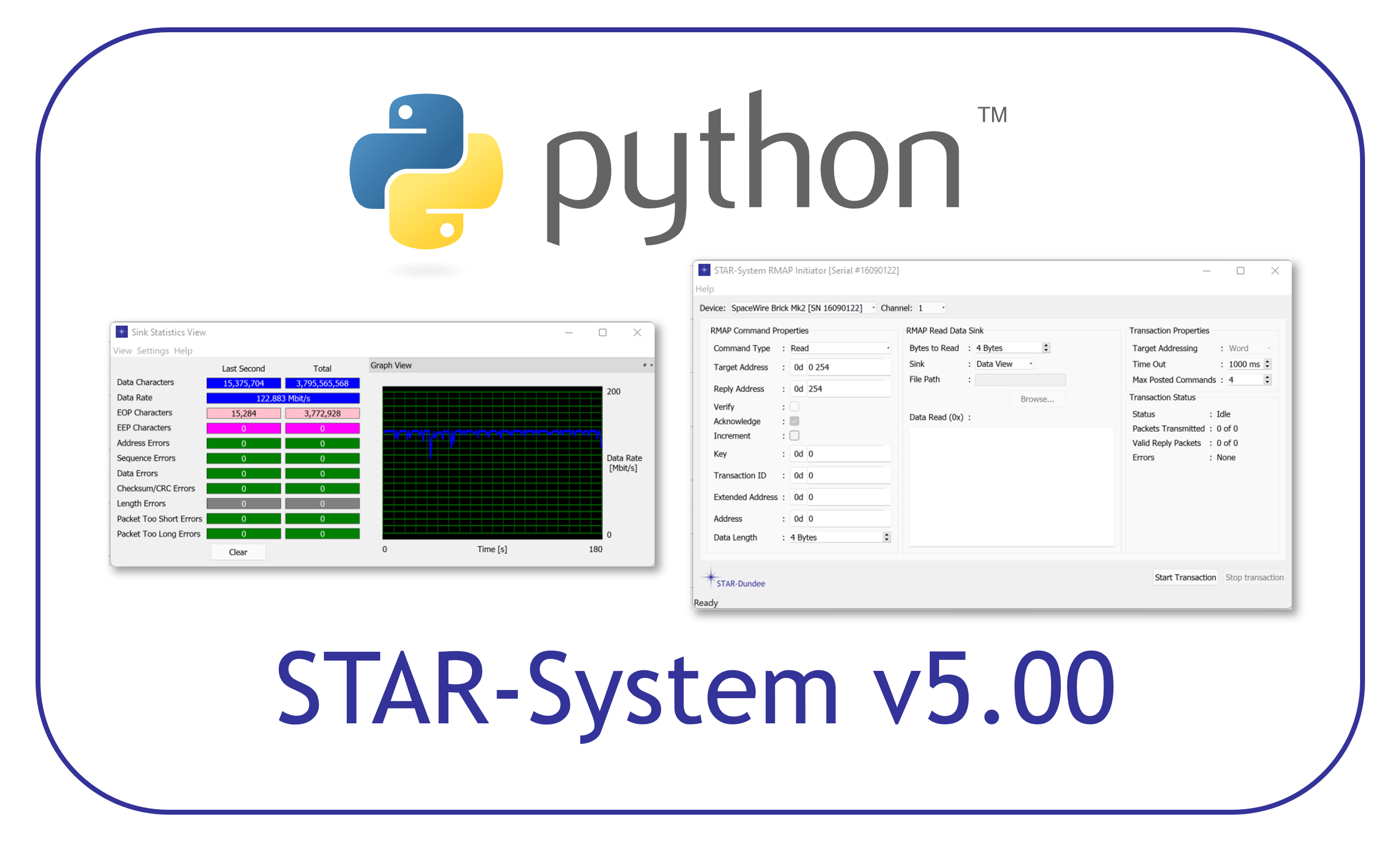
The STAR-System software suite has provided the drivers, APIs and applications to our SpaceFibre and SpaceWire products for over 10 years and continues to be updated with new features and improvements in each release. The latest major release, version 5.00, includes two features which we regularly receive requests for: an API for the Python programming language and a new Linux installer supporting ARM targets such as the Raspberry Pi and BeagleBone.
Other new features include a new API to support creation and processing of CCSDS Space Packet Protocol and Transfer Frame packets, and new graphical applications providing RMAP Initiator and Triggering functionality. The Source and Sink graphical applications have been updated to include graphs to visually represent statistics when transmitting and receiving, while there are numerous other improvements and bug fixes.
Version 5.00 has been successfully tested on Windows 11 and Linux kernel compatibility has been tested up to kernel v5.16.9. As with all STAR-System releases, version 5.00 is backwards compatible with previous releases and so any software developed for an earlier version will work with this latest release without requiring any modifications.
STAR-System version 5.00 is now available for download for registered users through the Support area of our website. If you don’t already have access to these downloads, please register your product on our Product Registration page.
Steve has been responsible for leading the development of SpaceWire and SpaceFibre computer network technologies for use on-board spacecraft. SpaceWire is being used in hundreds of spacecraft, costing in excess of $50 billion, which are monitoring the Earth, exploring our Solar System, and studying the universe. SpaceFibre is the next generation of this extremely successful technology, offering high-performance and high-reliability. It is already being designed into its first space applications and flying on two experimental spacecraft, OPS-SAT and NORBY.
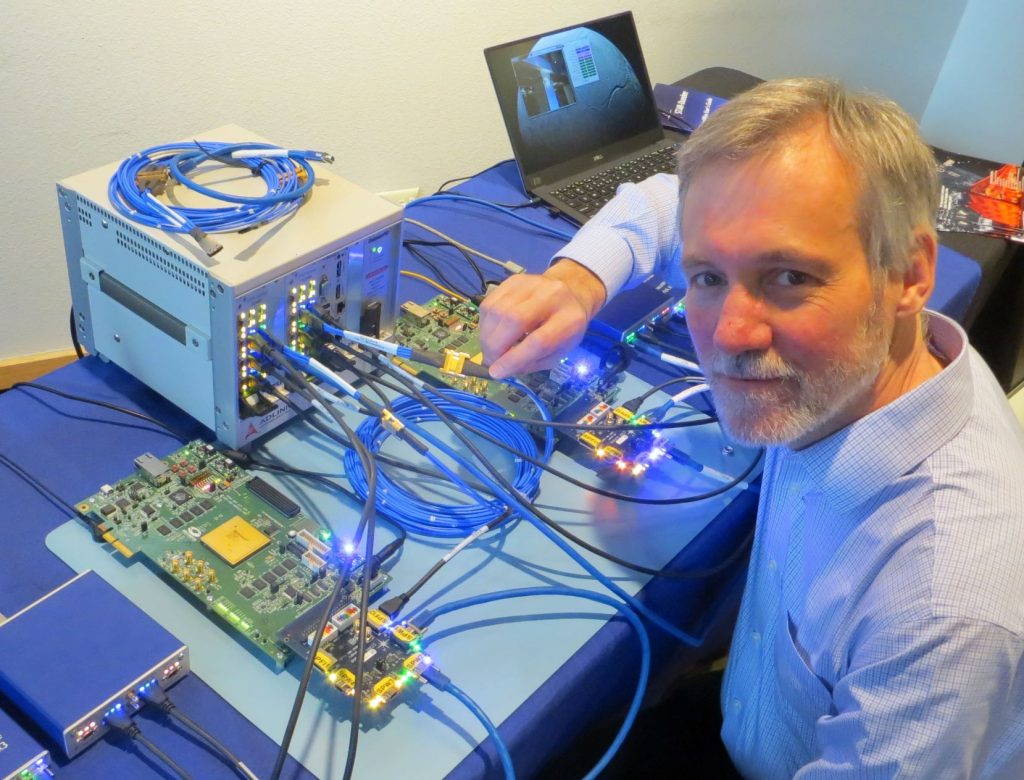
The first prototype SpaceFibre system being demonstrated by Steve in USA in 2017.
Steve has been a constant innovator over the past 26 years since he first moved to Scotland (living in Kirriemuir, Angus) and joined the University of Dundee, where he became Professor of Spacecraft Electronic Systems. He has worked extensively with the international aerospace industry and space agencies across Europe, USA, Japan and Russia, being recognised by the Saltire society for his international scientific work in 2019.
As examples of his world-leading reputation, in 2012 Steve was awarded a Specialist Bronze Award by the Royal Aeronautical Society for his “instrumental role in the inception, development and continuing success of the SpaceWire standard for spacecraft on-board data handling” and in 2013 he was one of the recipients of the European Space Agency (ESA) Award for Teamwork Excellence for the SpaceWire project.
Steve founded STAR-Dundee to help support users of SpaceWire in 2002, spinning the company out from his research group at the University of Dundee. He led the company for 15 years as Managing Director and then CEO. He became CTO in 2017 to focus on engineering and business development activities.
Stuart Mills, CEO of STAR-Dundee said: “Everyone at STAR-Dundee would like to congratulate Steve on this well-earned recognition. In addition to founding and leading the company until 2017, Steve is responsible for writing the SpaceWire, RMAP and SpaceFibre standards, with input from the international space community. As well as being used in many spacecraft, these standards are the key technologies on which STAR-Dundee’s great success has been built.
“In his position as CTO, Steve continues to innovate. In addition to overseeing our world-leading research and development activities, he is also contributing to the development of new open standards which will benefit the wider space community.
“STAR-Dundee would also like to extend our congratulations to all the newly elected Fellows. I am sure their capabilities will be of great benefit to the Academy in its important mission to create a sustainable society and an inclusive economy for all.”
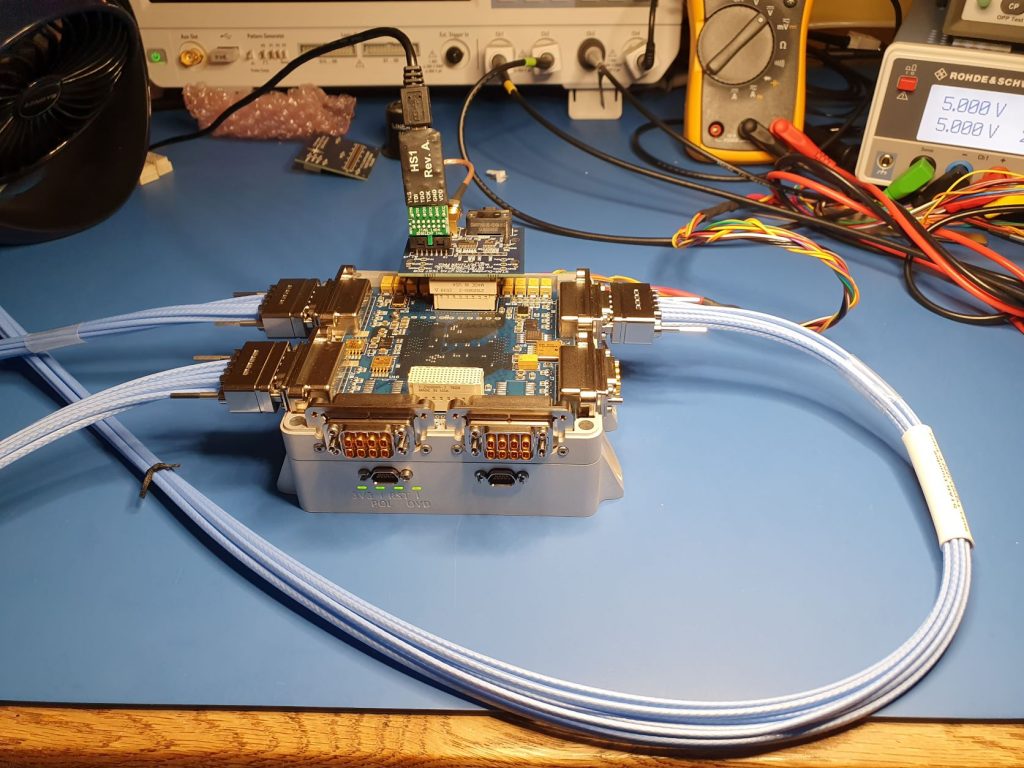
Steve’s dining room table during COVID-19, being used as the platform for the development and testing of the very latest SpaceFibre technology – in the heart of rural Angus!
Sir Jim McDonald FREng FRSE, President of the Royal Academy of Engineering, stated: “Our Fellows represent the best of the best in the engineering world, and we welcome these 69 excellent and talented professionals to our community of businesspeople, entrepreneurs, innovators and academics.”
“This year’s new Fellows are the most diverse group elected in the history of our institution. The engineering profession has long suffered from a diversity shortfall and the Academy is committed to changing that, including by ensuring that our own Fellowship community is as inclusive as it can be. It is well established that diverse organisations tend to be more agile and more innovative, and as the UK’s National Academy for engineering and technology, we have a responsibility to reflect the society we serve in addressing the shared challenges of our future.”